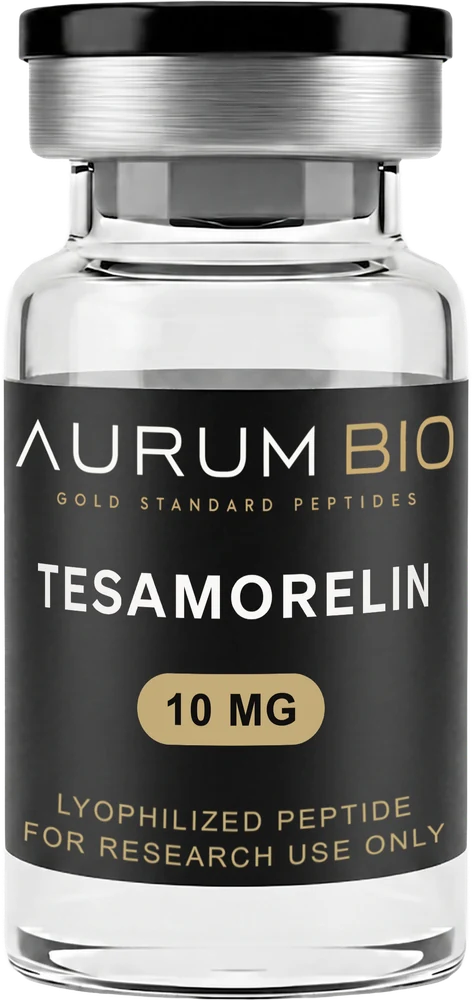

Tesamorelin vs. CJC-1295
Tesamorelin and CJC-1295 are both analogues of growth-hormone-releasing hormone, and they act on the same receptor. That makes them the closest true like-for-like pair in this catalogue — and it makes the gap between their two literatures the most instructive thing about the comparison.
Human GHRH is 44 amino acids long. Its problem, as a molecule, is fragility: DPP-4 cleaves it near the N-terminus and the circulating half-life is measured in minutes. Every GHRH analogue in existence is an answer to that problem, and the two here answer it differently — one by keeping the full sequence and shielding the vulnerable end, the other by cutting the sequence down and rebuilding the weak points.
Two engineering answers
| Tesamorelin | CJC-1295 (No DAC) | |
|---|---|---|
| Sequence | Full-length hGRF(1-44), C-terminal amide | Truncated GRF(1-29), four substitutions |
| Stabilisation strategy | trans-3-hexenoyl group attached at the N-terminal tyrosine | Backbone substitutions: D-Ala2, Gln8, Ala15, Leu27 |
| Receptor | GHRH receptor | GHRH receptor |
| Also known as | TH9507; the approved product is marketed as Egrifta | Mod GRF 1-29 |
| Evidence tier | Approved indication | Preclinical + early human |
| Published randomised trials | Multiple, including phase 3 | None located |
Why 1-29 exists at all
The truncation is not arbitrary. Early characterisation of GHRH established that the first 29 residues retain the full biological activity of the intact hormone — residues 30 to 44 are not required for receptor activation. GRF(1-29) is therefore the minimal functional fragment, and it became the standard starting point for analogue development because a shorter peptide is cheaper to synthesise and simpler to purify.
Tesamorelin took the other route. It retains all 44 residues and adds a trans-3-hexenoyl group to the N-terminal tyrosine — a small hydrophobic cap that obstructs the DPP-4 cleavage site without altering the backbone. The trade-off is a larger, more complex molecule that is harder to make, which is visible in the price of research-grade material across the market.
The evidence gap
This is the part of the comparison that actually matters, and it is where most write-ups treat the two as equivalent because they share a receptor.
Tesamorelin
Tesamorelin has been through the full clinical development pathway. Falutz and colleagues reported phase 3 results in the New England Journal of Medicine in 2007. Stanley and colleagues published a randomised trial in JAMA in 2014 examining visceral and hepatic fat, and a later randomised trial in Lancet HIV in 2019 examining liver fat. Separately, Baker and colleagues reported a randomised trial of GHRH administration and cognitive measures in Archives of Neurology in 2012. It holds an approved indication for HIV-associated lipodystrophy.
Whatever one thinks of the indication, the practical consequence is that the pharmacology of sustained GHRH receptor agonism in humans has been characterised — pharmacokinetics, IGF-1 response, the shape of the feedback, and adverse-event profile — in randomised, controlled populations of meaningful size.
CJC-1295
The published human record is two studies from 2006, both in the Journal of Clinical Endocrinology & Metabolism, both in small groups of healthy adults, and both concerning the DAC-conjugated form rather than the No-DAC form sold as research material. Teichman and colleagues characterised the prolonged GH and IGF-1 response; Ionescu and Frohman examined whether pulsatile secretion persisted under continuous stimulation.
That is the whole human dataset. There are no published randomised controlled trials, no phase 3 programme, and no approved indication. The No-DAC form specifically — the one most commonly supplied — has thinner published characterisation still.
Where the pharmacology genuinely differs
- Exposure shape. Tesamorelin's clinical characterisation is of a comparatively short-acting agonist; CJC-1295 with DAC produces a sustained elevation lasting days. The No-DAC form sits closer to tesamorelin in duration. Two agonists at the same receptor with different exposure profiles are not pharmacologically equivalent.
- Feedback engagement. Because both act upstream at the pituitary rather than supplying growth hormone directly, both remain subject to somatostatin tone and IGF-1 negative feedback. This is the shared feature, and it is a real one.
- Molecular complexity. 44 residues plus an acyl modification versus 29 residues with four substitutions — a meaningful difference in synthesis difficulty, and therefore in how much a certificate of analysis is worth checking.
Handling and identity
Both are supplied as lyophilized powder, reconstituted with bacteriostatic water, with lyophilized material stored at −20 °C and reconstituted solution held at 2–8 °C and protected from light. Both are among the more fragile compounds in a peptide catalogue and neither tolerates repeated freeze-thaw cycling well.
For tesamorelin, the identity question is whether the hexenoyl modification is present — an unmodified hGRF(1-44) would look broadly similar on a crude assay and behave very differently. For modified GRF(1-29), the question is whether all four substitutions are present. In both cases a molecular weight figure and a purity percentage are insufficient on their own; sequence or mass-spectrometry confirmation is what answers the question.
The short version
- Same receptor, two different solutions to the same stability problem — capping the full-length hormone, or truncating and rebuilding it.
- GRF(1-29) is the minimal fragment retaining full activity; that is why the truncated family exists.
- Tesamorelin carries randomised phase 3 evidence and an approved indication. CJC-1295's human record is two small 2006 studies of the DAC form.
- Evidence does not transfer between them on the strength of a shared receptor.
- Both are fragile and both warrant sequence-level identity confirmation, not just a purity figure.
References
- 01Falutz J, et al. Metabolic effects of a growth hormone-releasing factor in patients with HIV. New England Journal of Medicine, 2007.
- 02Stanley TL, et al. Effect of tesamorelin on visceral fat and liver fat in HIV-infected patients with abdominal fat accumulation: a randomized clinical trial. JAMA, 2014.
- 03Stanley TL, et al. Effects of tesamorelin on non-alcoholic fatty liver disease in HIV: a randomised, double-blind, multicentre trial. Lancet HIV, 2019.
- 04Baker LD, et al. Effects of growth hormone-releasing hormone on cognitive function in adults with mild cognitive impairment and healthy older adults: results of a controlled trial. Archives of Neurology, 2012.
- 05Teichman SL, et al. Prolonged stimulation of growth hormone (GH) and insulin-like growth factor I secretion by CJC-1295, a long-acting analog of GH-releasing hormone, in healthy adults. Journal of Clinical Endocrinology & Metabolism, 2006.
- 06Ionescu M, Frohman LA Pulsatile secretion of growth hormone (GH) persists during continuous stimulation by CJC-1295, a long-acting GH-releasing hormone analog. Journal of Clinical Endocrinology & Metabolism, 2006.
Citations are listed by title so they can be verified directly on PubMed. Identifiers are omitted deliberately rather than reproduced from memory.
FOR RESEARCH USE ONLY · NOT INTENDED FOR HUMAN CONSUMPTION. This article describes compounds and the research literature in which they appear. Nothing here is a recommendation, protocol, or statement of effect.