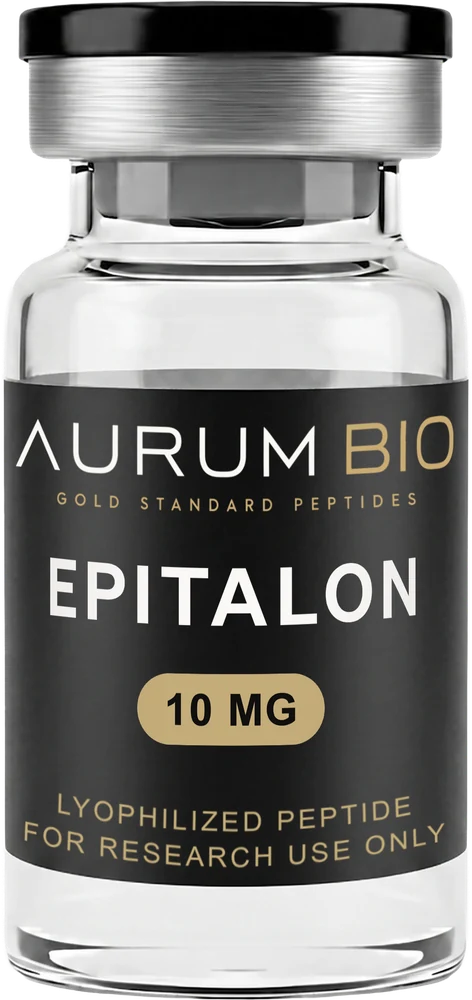
Epithalon: the telomere research peptide
If one peptide is tied to longevity folklore more than any other, it's Epithalon — the so-called telomere peptide. The actual evidence, the actual gaps, and the actual research, without the hype.
What is Epithalon?
Epithalon is a tetrapeptide — four amino acids: Ala-Glu-Asp-Gly. It emerged from a research program led by the Russian gerontologist Vladimir Khavinson, whose work on peptide bioregulators began in the 1970s with a pineal extract called Epithalamin. The synthetic tetrapeptide Epitalon/Epithalon (Ala-Glu-Asp-Gly) was developed later, in the 1990s. The underlying hypothesis: short peptides could regulate gene expression and slow aging.
Epithalon's primary proposed mechanism is telomere elongation. Telomeres are the protective caps at the ends of chromosomes. Each cell division shortens them slightly, and when they get short enough, cells stop dividing (senescence) or die — one proposed mechanism of aging, the "telomere theory of aging." The claim for Epithalon is that it activates the enzyme telomerase, which can rebuild and lengthen telomeres.
What is telomerase?
Telomerase maintains and rebuilds telomeres. It's present in stem cells and some immune cells, but most adult cells have very low activity. It has two components: TERT (telomerase reverse transcriptase, the catalytic subunit) and TERC (telomerase RNA component, the template). When active, telomerase adds DNA repeats to chromosome ends, counteracting shortening.
If a peptide could activate telomerase, it could — theoretically — slow or reverse telomere shortening.
What the research actually shows
Cell studies. In human fibroblasts and lymphocytes, reported effects include increased telomerase activity, reduced telomere shortening, increased cell lifespan, and reduced senescence markers. These aren't unique to Epithalon — several compounds affect telomeres in culture.
Animal studies. Khavinson's group reported lifespan extension in mice and rats (from a modest 5–7% to more, depending on the study), improved immune markers, and gene-expression changes.
The important context: many studies were conducted by Khavinson's own group in Russia. Russian gerontology has historically been viewed with some skepticism in Western science, publication venues are sometimes non-Western journals, and independent replication outside Russia is limited. This doesn't mean the research is wrong — it means the evidence base is harder to evaluate.
Human studies. Even more limited. Khavinson's group reported improved immune markers in elderly subjects, reduced respiratory infections in a small trial, improved sleep and well-being, and one study reporting reduced cancer incidence (a claim that needs extreme scrutiny). The problems are consistent: small samples, often not double-blind or placebo-controlled, conducted by the developers, published in hard-to-access journals, with no large Phase III trials. No well-independently-verified human trial has demonstrated telomere elongation from Epithalon in a rigorous, peer-reviewed, double-blind study.
The telomere hypothesis — current state
Telomere shortening is real and associated with health outcomes. But the therapeutic translation — "lengthening telomeres will slow aging" — is not clean. The complications:
- Cancer risk — telomerase is active in roughly 90% of cancer cells; artificially activating telomerase could theoretically promote cancer.
- Optimal telomere length — longer isn't necessarily better; the relationship isn't strictly linear.
- Cell-type specificity — a systemic activator would need to work on the right cells.
- Other aging mechanisms — telomeres are one of multiple hallmarks of aging.
What we don't know
Whether Epithalon reliably activates telomerase in humans; whether telomere elongation would produce meaningful benefits; its long-term safety; whether the cancer-risk concern is real; the optimal dose and protocol; how it compares to other interventions; whether the Russian findings replicate independently; and the mechanism beyond telomerase (some evidence points to gene-regulation pathways).
Epithalon in online peptide communities
Epithalon's reputation outsizes the evidence. A few reasons why:
- The story is compelling — "a peptide that rebuilds your telomeres."
- Telomere science is famous — popularized by Elizabeth Blackburn (2009 Nobel laureate) and Elissa Epel through their book The Telomere Effect, which created massive public interest. (David Sinclair, often invoked in these discussions, is associated with NAD+ and sirtuins — not telomeres.)
- It's been around a long time.
- Russian-science skepticism cuts both ways.
- The supplement loop — suppliers promote it, and community enthusiasm and commercial interest reinforce each other.
Epithalon vs. other longevity peptides
| Epithalon | NAD+ precursors (NMN, NR) | GLP-1 drugs | |
|---|---|---|---|
| Mechanism | Telomerase activation (proposed) | NAD+ restoration | GLP-1 receptor activation |
| Human evidence | Very limited, hard to verify | Moderate | Extensive |
| Cancer-risk concern | Yes (telomerase activation) | Unclear | Unclear (weight loss is protective) |
| Research maturity | Very early stage | Mid-stage | Well-established |
| Regulatory status | Not approved (research only) | Not approved as supplement in some countries | FDA-approved drugs |
Sourcing notes
- Availability — Epithalon is sold by research peptide suppliers.
- CAS number — 307297-39-8, useful for verifying identity against CoA data.
- Typical community protocol — 10 mg subcutaneous, often in cycles (e.g., 10 days on, 20 off). There is no established clinical standard for dosing or cycling.
- CoAs — essential.
The bottom line on Epithalon
It's a compelling story: a peptide that activates telomerase, rebuilds telomeres, and slows cellular aging. The reality is less certain. The telomere-elongation finding in human cells is interesting but not uniquely Epithalon's; the animal studies come from a limited program not broadly replicated by Western labs; and the human data is too thin and poorly verified to draw conclusions. The cancer-risk concern is legitimate.
For researchers, Epithalon deserves continued, independent investigation. For anyone else, the enthusiasm significantly outpaces the evidence — an interesting hypothesis to follow, not a proven intervention.
References
Citations are listed by title so they can be verified directly on PubMed. Identifiers are omitted deliberately rather than reproduced from memory.
FOR RESEARCH USE ONLY · NOT INTENDED FOR HUMAN CONSUMPTION. This article describes compounds and the research literature in which they appear. Nothing here is a recommendation, protocol, or statement of effect.