CJC-1295 & Ipamorelin: the GH peptide stack
When researchers look into peptides related to growth hormone, two names recur: CJC-1295 and Ipamorelin. Together, they're the most commonly studied growth hormone peptide combination in the research world.
What is growth hormone?
Growth hormone (GH) is a 191-amino-acid peptide hormone produced by the pituitary gland, affecting nearly every tissue. Its roles include stimulating cell growth and regeneration, supporting muscle protein synthesis, regulating body composition, maintaining bone density, and supporting immune function.
GH declines with age — a process sometimes called "somatopause." By 60, many people produce significantly less than they did at 20. Research interest in GH peptides stems largely from this decline, though the causal relationships are complex.
CJC-1295: overview
What it is. A synthetic peptide mimicking Growth Hormone-Releasing Hormone (GHRH), developed to stimulate the pituitary to produce and release more GH. It comes in two forms:
- CJC-1295 (without DAC) — the original; short half-life of roughly 30 minutes, producing a GH pulse lasting a few hours. Sometimes called "mod GRF 1-29."
- CJC-1295 with DAC — DAC (Drug Affinity Complex) binds albumin, extending the half-life to several days and allowing less frequent dosing.
How it works. It binds GHRH receptors in the pituitary, triggering release of stored GH in a pulsatile pattern similar to natural secretion — generally preferred over constant GH elevation, which more closely resembles acromegaly.
What the research shows. Human data is limited but not nonexistent. A notable study published in the Journal of Clinical Endocrinology & Metabolism in 2006 (Teichman et al.) found that a single injection of CJC-1295 with DAC elevated GH for roughly 6 days and IGF-1 for about 9–11 days in healthy adults. Other studies show similar GH-elevating effects in younger and older adults. What is not established: long-term safety, whether elevated GH translates into meaningful muscle gain or fat loss in humans, and optimal dosing.
Ipamorelin: overview
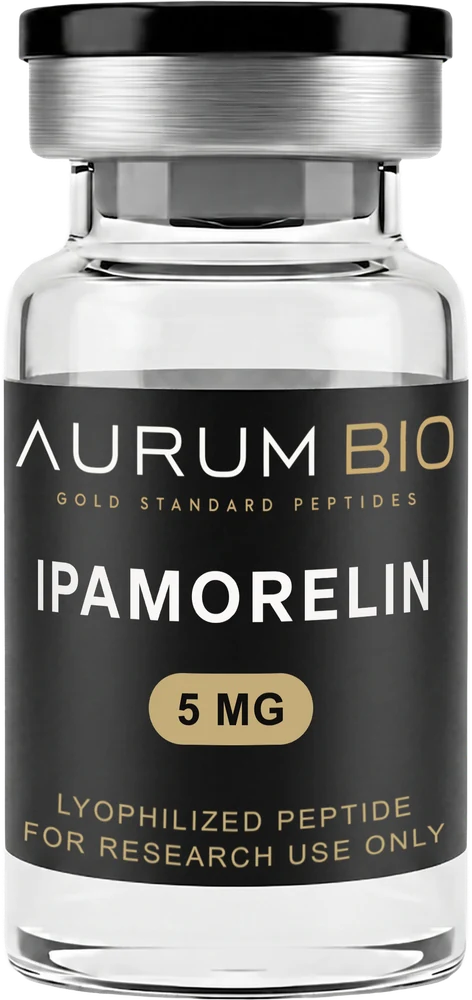
What it is. A synthetic pentapeptide (5 amino acids) acting as a Growth Hormone Secretagogue (GHS). It binds the ghrelin receptor (GHS-R1a). Unlike CJC-1295, which works through GHRH receptors, Ipamorelin works through the ghrelin pathway. It's considered a highly selective GHS.
How it works. Binding the ghrelin receptor stimulates the pituitary to release GH. Because it works through a different receptor than GHRH, its pulse differs in neuroendocrine profile and is additive to a GHRH analog's pulse.
What the research shows. Human research is very limited. The foundational characterization comes from Raun et al. (European Journal of Endocrinology, 1998), an animal study showing that Ipamorelin selectively stimulated GH release without significantly raising cortisol or prolactin — the basis for its reputation as a "cleaner" secretagogue. Animal studies show consistent GH elevation, but animal GH physiology differs from human.
Why they're used together: the stack hypothesis
The logic runs like this: CJC-1295 works via the GHRH pathway, Ipamorelin via the ghrelin/GHS pathway, and both converge on GH release through different mechanisms. Using both may produce a greater total GH pulse than either alone — think of pushing a door from two angles. Some researchers note the differing pulsatile patterns may create a more physiological stimulation profile.
What the evidence says: there is no published peer-reviewed study specifically examining the CJC-1295 + Ipamorelin combination in humans. The evidence is indirect — each elevates GH individually, they share the same final pathway, and there's no known antagonism. A plausible hypothesis, not proof.
Important differences between CJC-1295 and Ipamorelin
| CJC-1295 | Ipamorelin | |
|---|---|---|
| Amino acids | 29 (GHRH 1-29 backbone) | 5 |
| Mechanism | GHRH receptor agonist | Ghrelin receptor (GHS) agonist |
| GH release | Direct pituitary stimulation | Ghrelin pathway stimulation |
| Selectivity | Less selective (some cortisol effects) | More selective (minimal cortisol/prolactin) |
| Half-life | Short (non-DAC) / Long (DAC) | Relatively short |
| Side effect profile | Less studied in isolation | Early data suggests cleaner profile |
Common research questions
Does this work for muscle building? No peer-reviewed human study has demonstrated meaningful muscle gain from CJC-1295, Ipamorelin, or the combination in healthy adults. The research supports GH elevation, not specific body-composition outcomes.
Does this work for fat loss? No human clinical trials demonstrate fat loss from this stack.
What about IGF-1? IGF-1 is the primary mediator of GH effects. CJC-1295 elevates IGF-1 in human studies; Ipamorelin's effects on IGF-1 are less studied. Chronically high IGF-1 is associated with increased cancer risk in some studies — a legitimate, unresolved concern.
CJC-1295 vs. Sermorelin? Sermorelin is a GHRH analog — the first 29 amino acids of GHRH. CJC-1295 is a modified version of that fragment, with substitutions that increase potency and half-life, and is generally considered more potent.
What we don't know
- Long-term safety.
- Whether the stack changes body composition in healthy adults.
- Optimal dosing, timing, and cycle length.
- Interaction effects.
- Impact on IGF-1 over time.
- Effects in specific populations.
Sourcing notes
- CJC-1295 CAS — non-DAC (mod GRF 1-29) 863288-34-0; the DAC version is 446262-90-4. CAS assignments for CJC-1295 vary across sources.
- Ipamorelin CAS — 170851-70-4.
- Source from suppliers providing third-party CoAs; purity 95%+. Store refrigerated or frozen, protect from light, and reconstitute with bacteriostatic water or sterile saline.
The bottom line
CJC-1295 and Ipamorelin are two of the most studied GH peptide compounds, with demonstrated GH-elevating effects in human and/or animal research and a well-understood mechanism. Evidence for meaningful body-composition outcomes in humans is not established. The stack hypothesis is pharmacologically reasonable but not clinically validated.
References
Citations are listed by title so they can be verified directly on PubMed. Identifiers are omitted deliberately rather than reproduced from memory.
FOR RESEARCH USE ONLY · NOT INTENDED FOR HUMAN CONSUMPTION. This article describes compounds and the research literature in which they appear. Nothing here is a recommendation, protocol, or statement of effect.